What's a typical health insurance renewal increase for 2027?
Sep 03, 2026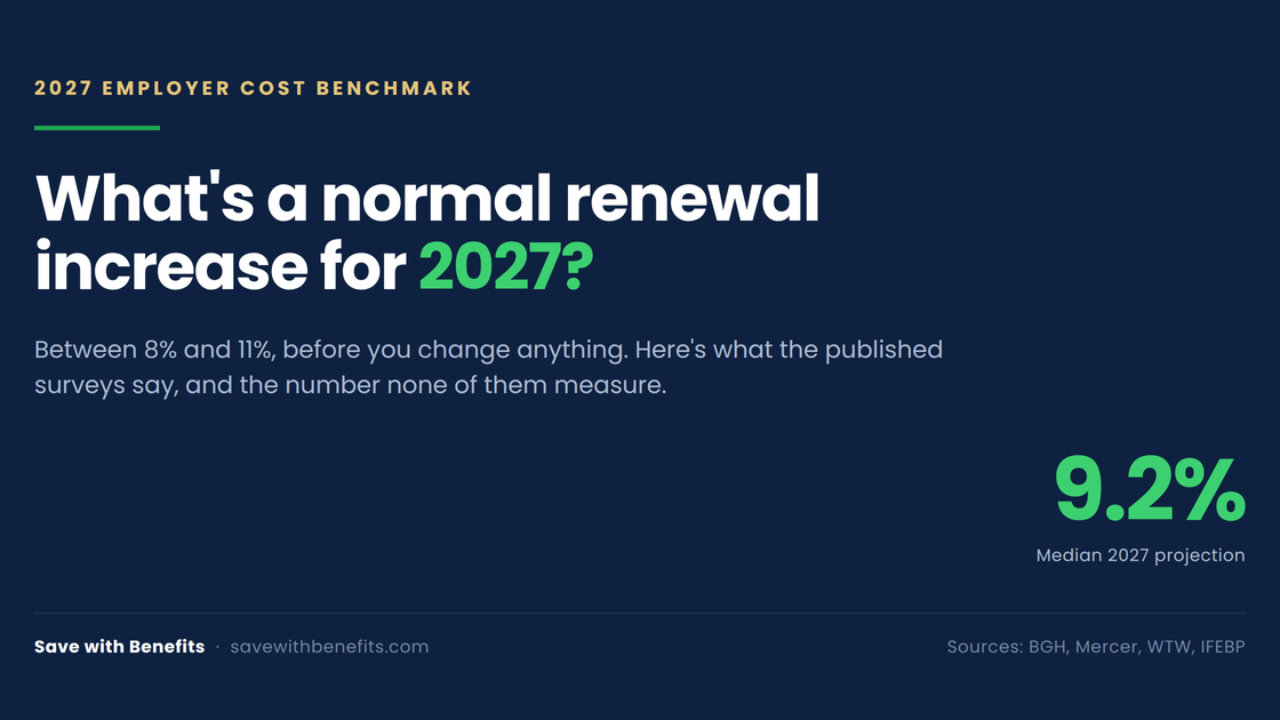
Between 8% and 11%, before you change anything. Large employers project a median 9.2% increase for 2027, or roughly 8% after raising deductibles and copays. WTW puts the pre-change figure at 11.1%. The International Foundation of Employee Benefit Plans reports a median of 10%.
If your renewal came back somewhere in that band, you're normal.
Normal is the problem.
Why it matters
Actual costs have beaten the forecast three years running, and each miss was bigger than the one before it. From 2018 to 2027, employer healthcare costs are tracking to a cumulative 76% increase. General inflation over the same stretch ran about 32%.
That isn't one bad year. It's the fourth consecutive one, with the fifth already budgeted.
What are the published 2027 benchmarks?
| Source | 2027 projection | After plan design changes |
|---|---|---|
| Business Group on Health | 9.2% median | ~8% |
| WTW | 11.1% | 9.7% |
| IFEBP | 10% median | Not reported |
| Mercer, 2026 plan year | 6.7% after mitigation | Above $18,500 per employee |
Business Group on Health surveyed 127 employers covering 11 million lives. Mercer surveyed more than 1,700.
Two drivers account for most of it:
→ Hospital prices. 62% of large employers name them a significant driver. 48% flag outpatient facility costs.
→ Pharmacy. Now 25% of total healthcare spend, projected up about 12% in 2026 and 12% again in 2027.
What is everyone doing about it?
Moving it onto employees.
48% of large employers expect to raise deductibles or copays for 2027. Paycheck deductions rise roughly in step with plan cost.
That works, in the sense that it moves the number. It also moves it onto the household budget of the person filling the prescription. A plan people can't afford to use is a line item, not a benefit.
What nobody benchmarks
Every survey above measures the increase. None of them measure the recovery.
That number exists. On the healthcare and benefits side, roughly $2,000+ per employee, per year is recoverable. About $100,000+ for every 50 people. Savings of 35% or more are achieved in 98% of engagements.
Indirect spend sits outside that figure and adds to it. Across 60+ categories, another 10 to 30%+ typically comes out, none of it on the benefits line at all.
None of this requires a plan design change. None of it requires a layoff. Nobody's deductible goes up.
Where the benefits-side recovery comes from:
→ 12% off medical. Better-rated doctors inside your current network. Same cards.
→ 15 to 25% off pharmacy, with 100% of rebates passed through to your plan.
→ $0 copay on 2,000+ prescriptions, brand and specialty included, some worth up to $1,900 per month at retail, for the whole household.
→ Payroll bolt-ons that generate cash back every pay period rather than costing anything.
Do you have to wait for renewal?
No, and this is where the industry read and our experience part ways.
Business Group on Health's own conclusion is that many employers won't have room for transformative moves until the 2028 plan year. That holds if the only lever is plan design, because plan design moves once a year on the anniversary date.
Most of these levers don't work that way. They bolt onto what you already have, go live in 30 to 45 days, in any month. Savings start Day 1 and land every pay period after.
What would you have to give up?
Nothing.
✓ Your broker. Keep the relationship. Bring them into the analysis.
✓ Your carrier, network, doctors and cards. No switching.
✓ Your payroll and systems. A pure bolt-on, backwards compatible.
✓ Your people. No layoffs, no cost shifted onto staff.
✓ Your team's time. Fully managed, no lift.
Every lever here lowers cost by improving what the member gets. Better coverage, not less.
How do you get your own number?
- A 15-minute call. Headcount, funding type, renewal date. We map which levers apply.
- A no-cost analysis. Usually one export that takes under two minutes to pull from payroll or accounting. No PHI, no RFP.
- You decide, we deliver. Live in 30 to 45 days.
$0 upfront, billed in arrears out of the savings created. No savings, no invoice. It never becomes a budget line. It creates room in one.
Questions people ask first
Is a 9% renewal increase normal for 2027?
Yes. Published projections run 8% to 11% depending on the survey and whether plan design changes are counted. Normal and acceptable are different questions.
Can costs go down without cutting benefits?
Yes. The savings come out of what care and overhead cost, not out of what members receive. Members get $0-copay prescriptions and better-rated doctors. Employers get fewer avoidable ER visits and surgeries. Nobody loses a benefit.
Is there a minimum company size?
One W-2 employee. At roughly $2,000+ per employee, per year on the benefits side, 12 people is $24,000. No ceiling either. Startups through the Fortune 500, all 50 states.
Do I have to change brokers?
No. These programs pay out of the savings they create, so they sit outside the channels brokers can reach. 99% of the brokers we talk to don't know they exist. Fixing that doesn't mean firing anyone.
How fast is payback?
There is typically Day 1 ROI with most programs. On contingency, billed in arrears out of savings generated.
What if we're self-funded?
Then the recoverable share is even larger, 35%+
What got postponed this year to absorb the last increase?
Sources
- Business Group on Health, 2027 Large Employer Health Care Strategy Survey (August 2026)
- Mercer, National Survey of Employer-Sponsored Health Plans and Survey on Health & Benefit Strategies for 2027
- WTW, Best Practices in Healthcare Survey preview (2026)
- International Foundation of Employee Benefit Plans, Pulse Survey: 2027 Cost Trend
Save with Benefits figures reflect stated and independently validated engagement results. Actual results vary. Not a quote, a bind, or tax advice.
Keryn Gold, PhD, MBA has spent 15+ years creating win-wins with 10x+ ROI, from startups to the Fortune 500. CEO, COO, and VC/PE M&A operator. She built the analytics, data science, and health economics centers of excellence at the country's largest healthcare payers, so she knows where the hidden costs sit. Today she runs Save with Benefits: lower employer costs with no layoffs, no disruption, and without upfront costs so there's Day-1 ROI.
About the author